Juilee Decker, Ph.D.
Museums. Public History. Empathy. Monuments. Memory. Biographer of Enid Yandell. Director, RIT's undergrad Museum Studies program.

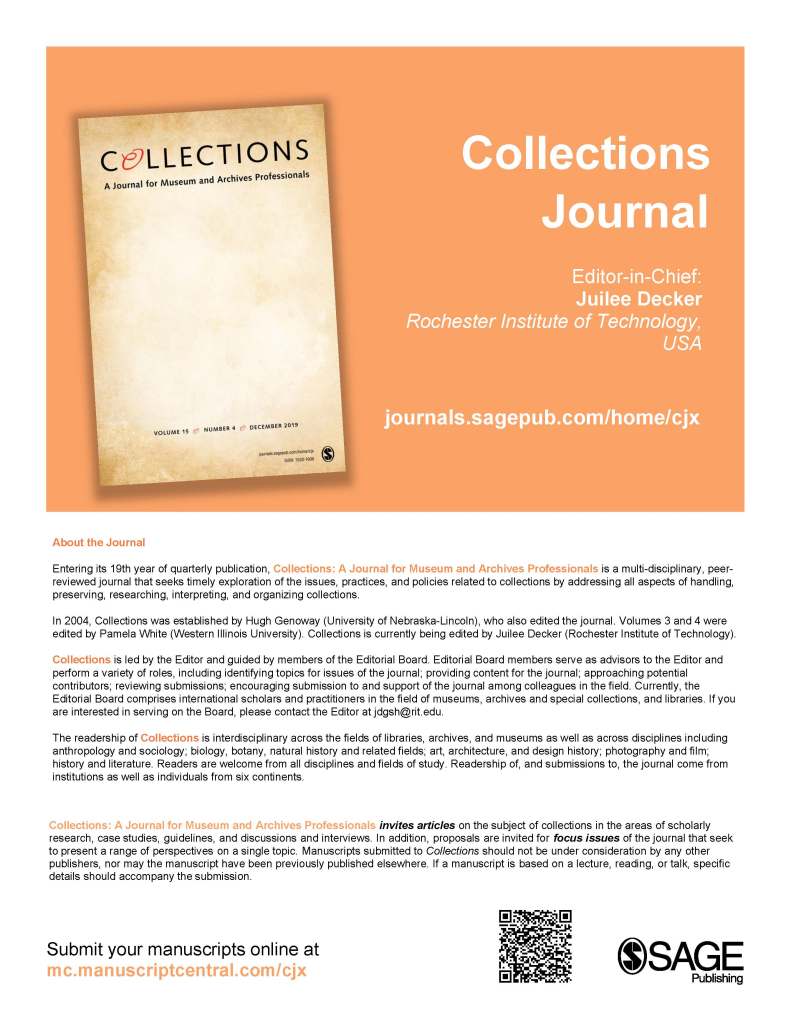
Collections: A Journal for Museum and Archives Professionals
Collections: A Journal for Museum and Archives Professionals seeks a new Editor-in-Chief (EIC) to begin in January 2026. Building upon the EIC and Editorial Board’s commitment to diversity, equity, and inclusion as well as the cultivation of emerging professionals to write and serve the journal in various capacities, the journal seeks an individual or team with the capacity and abilities to introduce, cultivate, and embrace new perspectives will lead the journal, and the field of collections, in unseen directions.
Collections: A Journal for Museum and Archives Professionals is not a society journal. It is a project of SAGE (initially published by Walnut Creek, AltaMira; and Rowman, before transitioning to SAGE in 2017). The relationship with SAGE affords opportunities for authors from across numerous fields and membership societies to bring their research to publication in a timely manner.
The Editor-In-Chief (EIC) is the head of the editorial team. The responsibilities include, but are not limited to:
- Coordinating and cultivating the journal’s Editorial Board;
- Convening the annual Editorial Board Summit once per year on Zoom (or similar platform);
- Advancing the Editorial Board’s Diversity, Equity, Inclusion, and Belonging initiatives;
- Working with the Editorial team/Editorial Board to develop Focus Issues which are curated around a theme and usually overseen by one or more members of the Editorial Board;
- Framing journal editorial policy jointly with SAGE, working with the Editorial team on development plans, indexing strategy, and initiatives decisioned by the Board;
- Actively recruiting authors to contribute to the journal;
- Promptly responding to author queries, escalating or referring any issues to SAGE as needed;
- Managing submissions
- Inviting referees from personal network, connections of the Editorial Board, and online submission site for papers assigned on the system
- Rendering a final decision on all submissions
- Ensuring an adequate flow of material to meet the publication schedules;
Application requirements:
The EIC may come from research, practice, or both, and will seamlessly navigate the spaces of archives, museums, and special collections, with an eye to collections (rather than curatorial or other matters, primarily). The EIC will have the support, expertise, and leadership of the international Editorial Board who reflect diverse geographies, perspectives, approaches, and capacities.
- Current curriculum vitae, including a list of publications
- Letter of intent explaining your interest in the role
Recent articles have addressed the following areas of interest: women and museums; photographic preservation and collections management; the Smithsonian Institution Transcription Center; Atlantic world archives of Louisiana; provenance research; legal issues involving collections; and “hazardous heritage” involving dangerous materials in cultural heritage.
About the journal:
Established in 2004, Collections: A Journal for Museum and Archives Professionals publishes multi-disciplinary, peer-reviewed explorations of the issues, practices, and policies related to collections. The journal addresses all aspects of handling, preserving, researching, interpreting, and organizing collections. Archivists, librarians, curators, collections managers, registrars, scholars, and professionals at every stage of their research and practice contribute to the journal, serve as peer reviewers, and comprise the Editorial Board.
Key links:
- Journal homepage
- Editorial Board
- About the journal
- Author guidelines
- Submission site
- Published articles
Terms:
The EIC term is three years, with annual renewal following that period. Should an Editor wish to continue their tenure, they are eligible to serve two 7-year terms on a single journal for a total of 14 years.
Upon being named the incoming Editor-in-Chief, the candidate will undergo a period of orientation with the journal’s current Editor, Dr. Juilee Decker, jdgsh@rit.edu, will precede the beginning of the term (November-December 2025).
The position is supported by an annual honorarium from SAGE.
How to apply:
All applications and questions should be directed to the journal editor, Dr. Juilee Decker, jdgsh@rit.edu, by March 1, 2025. The announcement will be made by July 1, with the orientation to begin in November 2025.
Call for Submissions: “Re-Collections”
Seeking authors for a focus issue of the journal Collections
looking at pasts, the present, and the futures of collections
Established in 2004, Collections: A Journal for Museum and Archives Professionals is a multi-disciplinary, peer-reviewed journal that seeks timely exploration of the issues, practices, and policies related to collections by addressing all aspects of handling, preserving, researching, interpreting, and organizing collections. Archivists, librarians, curators, collections managers, registrars, scholars, and professionals at every stage of their research and practice contribute to the journal and serve as reviewers and members of the Editorial Board.
In celebration of our journal’s 20th year, the Editorial Board of Collections invites shorter pieces, up to 1,000 words with reflections on the field of museum and archives collections. This call is extended to both seasoned and newer voices to bring experienced and fresh perspectives on museum and archive collections as a series of re-collections. As a focus issue, “Re-collections” will explore the pasts, present, and futures of collections by interstitially linking varied perspectives: we hope to provide space for examination of the field—where it has come from, where it is now, and where it may be headed.
Authors for this focus issue may be scholars or researchers affiliated with any collection-based institution, college, university, or research institution as well as graduate students, emerging professionals in museums, archives, and cognate fields.
Guidelines:
- The submission may be no longer than 1000 words and may contain up to 2 images/figures.
- The submission has not been previously published, nor is it before another journal for consideration (or an explanation has been provided to the editor beforehand).
- The text is double-spaced; uses a 12-point font; employs italics, rather than underlining (except with URL addresses); and all illustrations, figures, and tables are complete, with caption and credit.
- All authors will be asked to disclose any funding sources and to affirm no conflicts of interest.
- Key links:
Questions may be directed to the Journal Editor, Juilee Decker, jdgsh@rit.edu. Deadline: February 1, 2025 via https://mc.manuscriptcentral.com/cjx. Due to the nature of this call, notes and bibliographies are not required for submissions. Up to 40 submissions, worldwide, will be accepted for this focus issue.
Members of the AIC Collection Care Network attending the AIC’s 50th Annual Meeting in Los Angeles are invited to the Idea Fair to learn more about the journal Collections: A Journal for Museum and Archives Professionals.
For up-to-date listings of public talks/free see https://juileedecker.com/talks/
Collections: A Journal for Museum and Archives Professionals invites articles on the subject of collections in the areas of scholarly research, case studies, guidelines, and discussions and interviews. In addition, proposals are invited for focus issues of the journal that seek to present a range of perspectives on a single topic. The journal also publishes book reviews.
Manuscripts submitted to Collections should not be under consideration by any other publishers, nor may the manuscript have been previously published elsewhere. If a manuscript is based on a lecture, reading, or talk, specific details should accompany the submission. A complete manuscript submission shall include the following:
• An abstract of no more than 150 words
• Manuscript (At the head of your submission, please include appropriate contact details that will appear in print. Contact details should include: name, title, institutional affiliation, and email.)
• Notes, References (Bibliographies and references should conform to Chicago Manual of Style, 17th edition, Notes and Bibliography)
• Illustrations, unlimited. Captions should include appropriate credits. Authors are responsible for observing the laws of copyright when quoting or reproducing material and for any reproduction fees incurred.
• Agreement (as part of the review process, an agreement will be sent to you).
Submit your manuscripts online at mc.manuscriptcentral.com/cjx. Journal information may be found here.
View the journal archive here: https://journals.sagepub.com/toc/CJX/current.
Remembrance of Things Cast: Monuments and Memorials in the Age of #TakeItDown
Edited by Juilee Decker, Associate Professor of History, Rochester Institute of Technology
Initial Interest Deadline: January 31, 2021 via email jdgsh@rit.edu
Cast in bronze, stone or otherwise created of seemingly permanent materials, monuments and memorials bear witness to valor, heroics, or tragedy associated with a person or historic event: as embodied narratives in the public realm, these works perpetuate, both implicitly and explicitly, the proxy battle for a community, culture, or nation’s past. However, national reckonings on racial injustice in the United States, United Kingdom, and elsewhere have re-positioned monuments and memorials as an historical tripwire drawn taught by issues of race, colonization, and marginalization. Mounting concerns over extrajudicial killings of black men in the United States and national reckonings on social injustice have played out in our town squares, boulevards, university quadrangles, and administrative edifices in the form of protests, open calls for change, and action. Such grassroots initiatives have made clear how the visual (and nominal) remembrances of some contested historical figures undermine policies and practices of the institutions and communities where their likenesses exist. Thus, efforts entitled #TakeItDown, #RemoveConfederateStatues, and #RhodesMustFall, have recoiled at the very role of such representations and have born witness to acts of destruction, iconoclasm, removal, recontextualization, and/or re-presentation. In particular, the removal of the statue of British imperialist and politician Cecil Rhodes from its plinth at the University of Cape Town in April 2015 has spawned a wide-sweeping reconsideration and re-framing of memorials to figures involved in the Atlantic slave trade, British colonialism, absolute rule, white supremacy, and genocide.
Acknowledging the ways in which the past—which is embodied through monuments and memorials—intrudes into daily life in immediate, persistent, and anxious ways, this call for chapters seeks contributions from researchers, scholars, and practitioners that answer questions about the roles that monuments and memorials play in the staging of cultural, regional, national or other dramas as well as their anxieties, fears, and fabrications. By using monuments and memorials as lenses through which to view race, memory, and the legacies of war, power, and subjugation, this volume aims to show how these works and their visible representations of entitlement, possession, control, and authority can offer, anew, the opportunity to pose and answer questions about whose memory matters and what our symbols say about who we are and what we value. For it is through their desecration, destruction, removal, and re-contextualization, that monuments and memorials can lay to rest those values for which communities no longer have any use. The sculptures become a remembrance of things cast.
This edited volume seeks chapters comprising 5,000 words from authors whose research, scholarship, and/or public practice considers monuments, memorials, public memory, identity, and representation from across the globe. Given the impact of contemporary issues surrounding 19th-and 20th-century constructions, chapters focusing on monuments and memorials created during this era are of primary focus; although authors may tell the stories of earlier material culture and sites and their contestation, as long as the acts of destruction, iconoclasm, removal, recontextualization, and/or re-presentation have occurred since 2015, the age of #TakeItDown. Please note thatdiscussion of earlier acts of destruction, iconoclasm, or removal (prior to 2015) is viable only if new meanings, contextualizations, or re-considerations have occurred since 2015 that dramatically alter our understanding of the monument or memorial.
Possible topics might include:
- case studies of the destruction, iconoclasm, removal, recontextualization, and/or re-presentation through repair of a monument or memorial since 2015 and the implications of these acts
- discussion of grassroots iconoclasm in the 21st century, including the toppling of any monuments other than the bronze of Edward Colston, which was forcibly removed in June 2020 in Bristol, UK
- analysis of how the removal of monuments and memorials contest historiographies and hagiographies
- positioning of acts of destruction as performative, recursive, or dialogic
- examination of how the modification or destruction of monuments and memorials may be seen as a performative act that questions the political power configured in public space or that questions how public space shapes public memory and politics
- address of the ways in which the disruption of the built environment through monument and memorial removal, in turn, fractures understandings of history, memory, identity, bias, and representation
- discussion of elision from our built environment
- critique of how, through presence and subsequent absence, monuments and memorials offer insight, perspectives, and understandings of communal identity, continuation, and aspiration
Each chapter shall be 20 pages double-spaced plus notes, references, and no more than 2 images. Authors should express their interest by submitting a 500-word abstract, short bio, and any relevant information (such as pertinent URLs) to Juilee Decker jdgsh@rit.edu, by January 31, 2021. Notification of acceptance will be made by February 22, 2021. The abstracts of the proposed chapters and the framing context for the edited volume will undergo peer-review, after which accepted authors must adhere to a deadline of late summer 2021 for completed manuscripts.
The chapters will be positioned in a volume to be published by a major scholarly press. While an editor at Routledge has expressed interest in the volume for their Museum & Heritage Studies list, all materials must undergo peer review before any commitment is made by the publisher.
—– —– —–
About the Editor: Juilee Decker, Ph.D. is an associate professor of history and director of the museum studies + public history program at Rochester Institute of Technology. Her research excavates histories and functions of museums and memorials as part of the process of understanding and critiquing constructions of knowledge and public memory in the U.S. In addition to her publications focused on museums and collections as well as exhibitions, Decker has served as an invited scholar for two National Endowment for the Humanities convenings around monuments and the Civil War (2013 and 2016). She has just completed a history of the national outdoor sculpture initiative in the US (forthcoming) and is currently at work on a manuscript focused on monuments, memorials, meaning-making, and memory practices in Kentucky. Decker earned her Ph.D. from the joint program in art history and museum studies at Case Western Reserve University and the Cleveland Museum of Art.
Collections: A Journal for Museum and Archives Professionals
Call for Editorial Board Members
Published by SAGE journals, https://journals.sagepub.com/home/cjx
See free sample issues here: https://journals.sagepub.com/toc/cjxa/15/1
Founded in 2004, Collections: A Journal for Museum and Archives Professionals is a multi-disciplinary journal addressing all aspects of handling, preserving, researching, understanding, interpreting, and organizing collections.The journal addresses the subject of collections in the areas of scholarly research, case studies, discussions and interviews, and other forms of publishable, peer-reviewed scholarship. Archivists, librarians, collections managers, preparators, registrars, educators, other professional staff, graduate students, academics, researchers, and others submit their work for review.
As a member of Collection‘s editorial board, you have a key role in the publication process and the success of the journal. The publication process is a collaborative venture: the Editor, the Editorial Board, SAGE, and authors contribute to and benefit from the journal in a range of capacities.
As a member of the Editorial Board, you will work closely with the Editor and colleagues to achieve the journal’s mission and, moreover, contribute to the journal in a variety of ways. Key among these are peer review and guest editorship. In terms of peer review, members of the Editorial Board may be asked to review or arrange for peer review of a reasonable number of manuscripts per year. The average length of an article or review essay is 15-25 manuscript pages (3750—6250 words); however, manuscripts range in length from a few pages to chapter-length studies.
Editorial Board members may assist in:
- developing concepts for themed issues of the journal and locating guest editors, as appropriate, for such issues. For example, two special issues of the journal dedicated to women and collections were guest-edited by Consuelo Sendino, Margot Note, and Janet Ashton; S. Terry Childs and Gwenn Gallenstein guest-edited our forthcoming issue focused on archaeology and collections (in 2021); and Carrie Meyer has guest-edited our forthcoming issue focused on COVID-19 (in 2021).
- encouraging appropriate submissions from a range of museum and archives professionals;
- providing contributor contacts for the Editor to solicit manuscripts;
- assisting the Editor in keeping abreast of trends and issues in the field;
- helping to bring completed articles to their highest quality of content and form; and
- broadening the discourse about collections to our national and international readership.
Names of the Editorial Board are proudly featured on the journal website and appear in each issue of the journal. Members of the Editorial Board, also, receive full access to the journal during their three-year tenure. Appointment to the Board is renewable.
I hope that you will accept this invitation to serve on the board. I would be delighted to have you join me, and SAGE, as a member of the Editorial Board of the journal Collections: A Journal for Museum and Archives Professionals.
Sincerely,
Juilee Decker, Ph.D.
My collaborator, John Äasp, and I are thrilled to announce that we are bringing Félix González-Torres’s Untitled (LA), 1991 to Rochester Institute of Technology’s RIT City Art Space, located in the historic Sibley Tower building at Liberty Pole Plaza. City Art Space is the College of Art and Design’s premier exhibition and event space in the center of downtown Rochester, NY. The work will be on view from November 2020 through February 2021, for which we have planned a slate of events. Stay tuned for more information and our upcoming collaboration with The Bass Museum, Miami, FL.
“Making and Meaning: A Conversation with Betsy Greer & Crafting Democracy Artists”
Thursday, October 29, 6 pm
Organized by Juilee Decker
Join us for a conversation about craftivism with stitcher, writer, and maker Betsy Greer (hellobetsygreer.com) and artists whose works are featured in the exhibition Crafting Democracy. We will also invite attendees to share their thoughts about the importance of craft and activism, its multiplicity of form, and potential for meaning-making.
Location: Zoom

Topics of Interest: Almost anything involving XR and immersive technologies is within the scope of the symposium. Papers, talks, workshops, demos, installations, performances, works-in-progress, and flash talks may cover any of the following topics:
Technology and analysis (system design, displays, optics, engineering, perception)
- Theoretical Foundations (approaches as well as theories and aesthetics of XR)
- XR Practices and Case Studies involving game design, storytelling, theatre, artistic expression, documentary, museums and cultural heritage, and health and well-being
- XR Studies and Education (as a discipline or method, in formal and informal education)
- History and Impact (analysis, critical history, societal impact, and influence on contemporary culture)
- Analyses and Evaluation of Systems (UI/UX, affect and emotion, presence and engagement)
- Archiving and Preservation of XR experiences as well as the use of these technologies to preserve cultural heritage and archaeological sites.
- Universal Design, Accessibility, and Inclusion (embodiment, modality, empathy, and representation)
- Public Interest Technology (XR design, product development, journalism, or content created for the common good, social justice, or to serve the public)
Please consider submitting an abstract even if your research area is not listed above, as we seek broad and inclusive approaches to the concepts and themes related to XR. Info here: http://framelesslabs.rit.edu/symposium-2020/.
 Juilee Decker, Ph.D.