Juilee Decker, Ph.D.
Humanities Scholar | Cultural Heritage Imaging Researcher | Museum Studies Educator | Builder of International Research Networks
Funding & Impact
Transforming Ideas into Action
“The impact of this work can be seen not only in publications or projects, but also in the communities that have formed around shared goals, the students whose careers have been shaped through participation, the institutions that have gained new capabilities, and the cultural heritage materials that have become more accessible to researchers and the public.” Juilee Decker, Ph.D., humanities scholar, cultural heritage imaging researcher, museum studies educator, builder of international research networks
Research requires imagination, but meaningful impact requires resources, partnerships, and sustained commitment. I value and embrace all three of these strategies in my work to foster meaningful relationships with partners that extend beyond the confines of grants and deadlines.
My work has been supported through competitive grants and partnerships that have enabled the development of new technologies, educational opportunities, research initiatives, exhibitions, and international collaborations. Support from the National Endowment for the Humanities and private foundations has made it possible to develop infrastructure that strengthens both scholarship and public engagement.
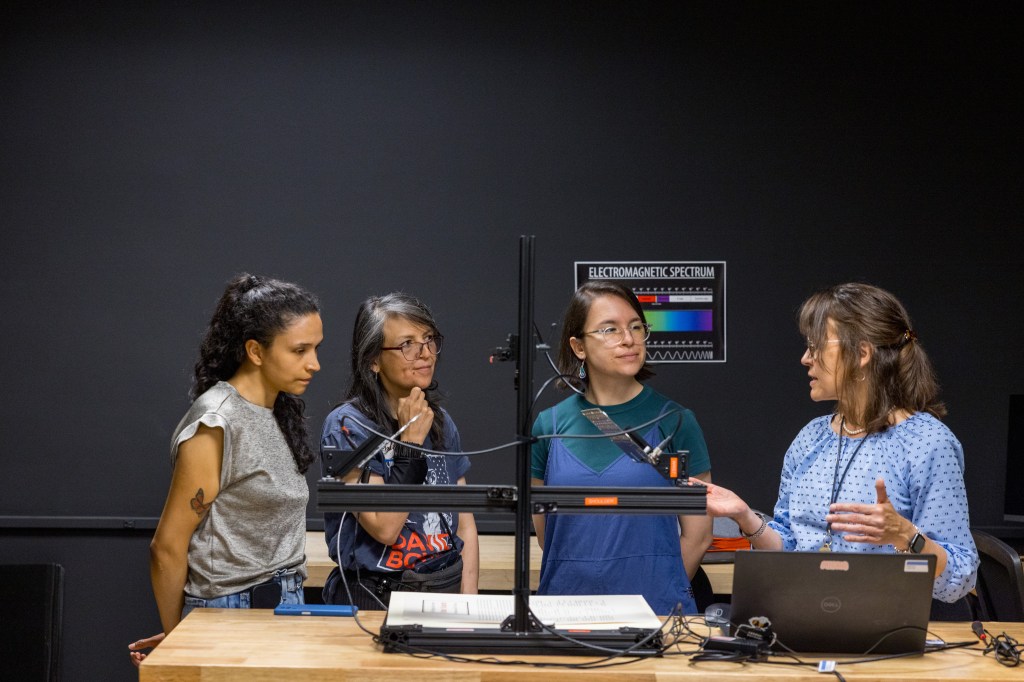
- National Endowment for the Humanities (NEH) Preservation & Access, Research and Development, Tier 2, $350K, awarded in 2020: “Low-Cost End-to-End Spectral Imaging System for Historical Document Discovery” focused on three efforts: developing a system and software; teaching non-scientists how to use it; once open-source, developing basic training materials.
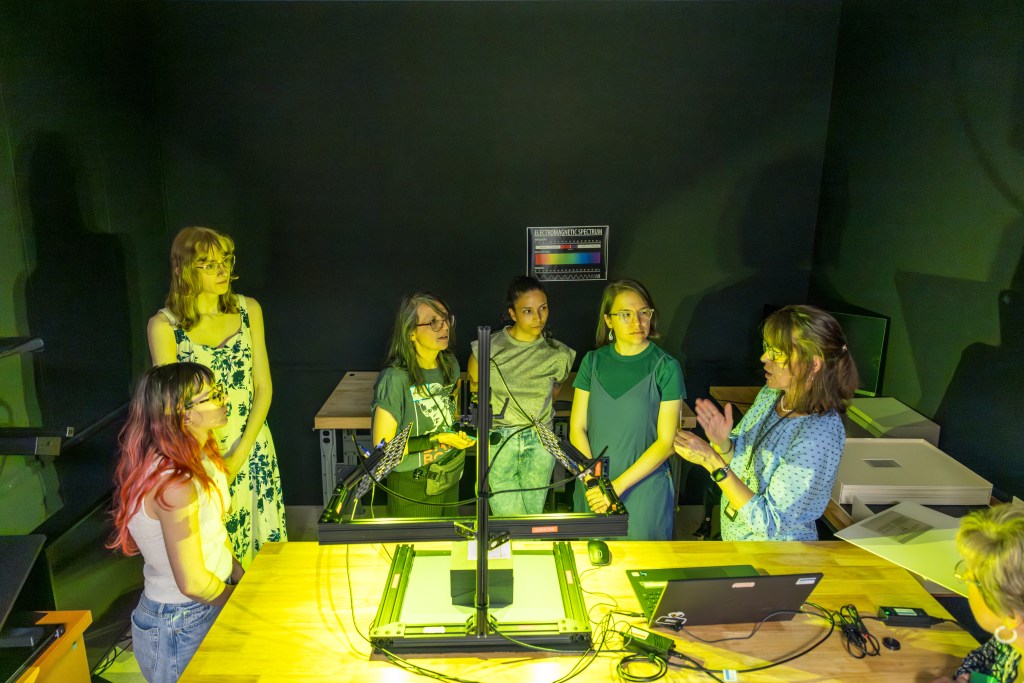
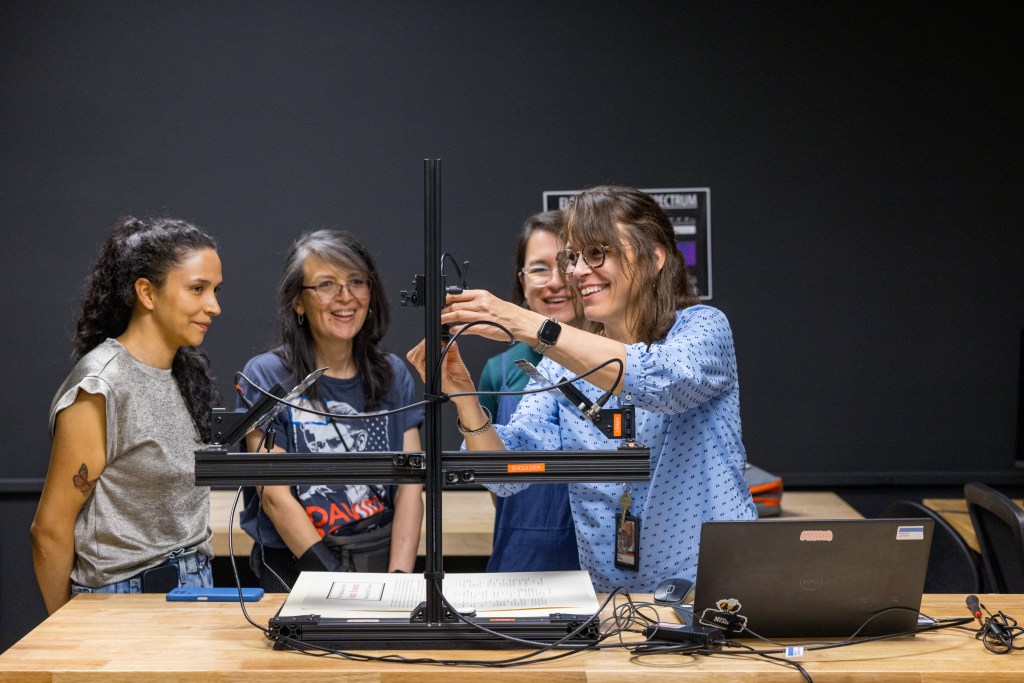
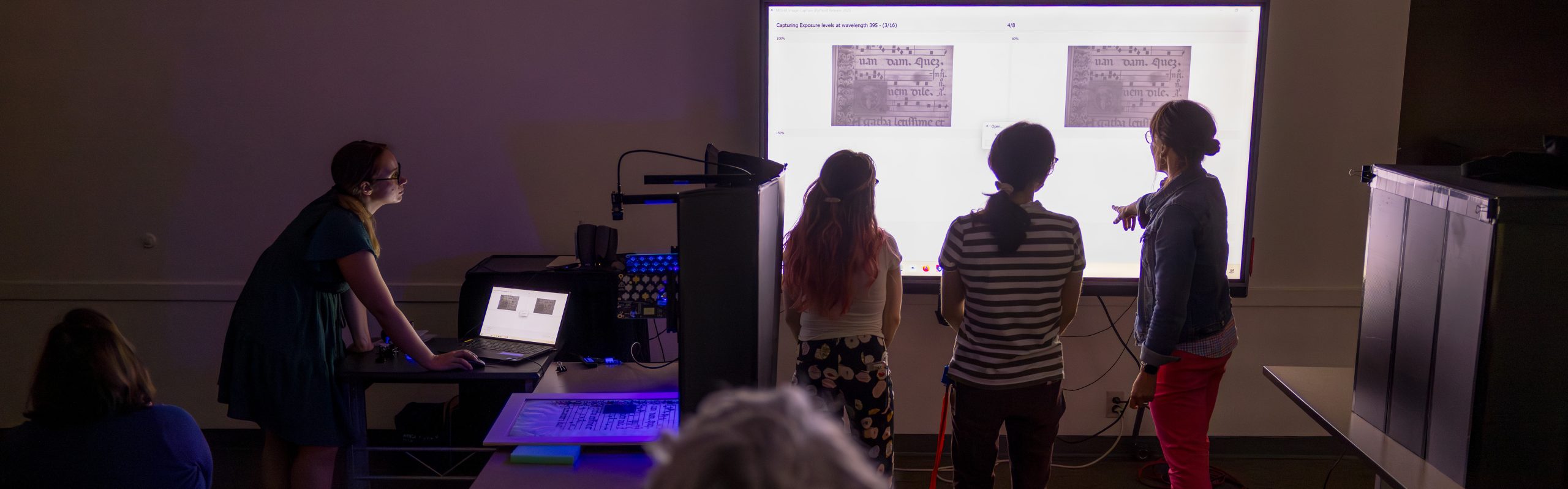
Most research libraries and museums hold unique or rare items on which historically significant text is no longer legible due to deterioration or erasure. Spectral imaging – the process of collecting images of objects in many wavelengths of light – has become one solution for recovering obscured and illegible text on historical materials. Unfortunately, these systems are very expensive, and require knowledge of image processing methods. Most libraries and museums cannot afford these systems, nor do they have the capacity to process the data. To mitigate this, we propose to develop a low-cost spectral imaging system with accompanying low barrier-to-entry software. - National Endowment for the Humanities (NEH) Preservation & Access, Education and Training, $350K, awarded in 2024; terminated in 2025; to be reinstated in 2026: “Creating Multispectral Imaging Communities of Practice to Expand Access and Discoverability” focused on the creation of online and in-person training programs, as well as an equipment-lending program, to promote the use of Multispectral Imaging System for Historical Artifacts (MISHA) and develop communities of practice.
The Museum Studies program in the College of Liberal Arts and Chester F. Carlson Center for Imaging Science propose to develop and sustain education and training opportunities for library, archive, and museum professionals, humanities scholars, and others through the creation of “communities of practice” around multispectral imaging to foster opportunities for discoverability, expanded access, and preventative collections care. This project builds upon our previous Tier 2 R&D grant that yielded the creation of an accessible, user-friendly multispectral imaging system and software. The program will utilize three modalities (online; onsite at RIT; and offsite through a loan program) and will give participants opportunities to apply the technology to their own collections. By centering on participants from four professional constituencies in the US, the project aims to develop multispectral imaging literacy among those who may not have access to such resources. - Whiting Foundation, multiple grant efforts since 2024 that have focused on relationship-building. Two key efforts are based in Colombia and Iraq in partnership with Colombia’s National Library; Mosul Heritage Library in Iraq and a third partner. The goal is to train and equip local stewards to deploy a new low-cost multispectral imaging system – a noninvasive technology that can reveal erased and eroded text.
- Art Bridges Foundation, 2020-2025, as part of a five-year effort to enable a series of exhibitions and public programs centered on the work of artists including Félix González-Torres, Ana Mendieta, Nicholas Galanin, Jack Levine, and Augustus Saint-Gaudens. The lessons learned continue to inform my work today, raising forward-looking questions about how museums, archives, libraries, and universities can leverage technology, community partnerships, and interdisciplinary collaboration to create more responsive, inclusive, and participatory cultural experiences. In this regard, funding did more than support a series of exhibitions—it helped create a framework for reimagining how cultural organizations connect people, ideas, and communities in the future.
I view funding not as an endpoint, but as a catalyst. Grants create opportunities to bring people together, test new ideas, build sustainable systems, and expand access to knowledge. Through sponsored research, I have worked to support student learning, foster international partnerships, develop open resources, and create technologies that serve cultural institutions around the world.
As far as exhibitions, funding often serves as a catalyst for experimentation, allowing cultural institutions and scholars to test new ideas, reach new audiences, and build relationships that endure beyond the duration of a grant. For a five-year period, in partnership with my colleagues John Aasp and with the support from Art Bridges, we created a series of exhibitions and public programs centered on the work of artists including Félix González-Torres, Ana Mendieta, Nicholas Galanin, Jack Levine, and Augustus Saint-Gaudens. Rather than viewing exhibitions solely as spaces for display, these projects explored how museums might function as sites of dialogue, participation, reflection, and connection during a period of unprecedented social isolation. The initiative encouraged audiences to engage with questions of identity, memory, belonging, social justice, and civic responsibility while experimenting with new forms of public participation that extended beyond gallery walls. Equally important, the project demonstrated how strategic investment in exhibitions can generate broader conversations about access, engagement, and the role of cultural institutions in times of disruption.
“The lessons learned continue to inform my work today, raising forward-looking questions about how museums, archives, libraries, and universities can leverage technology, community partnerships, and interdisciplinary collaboration to create more responsive, inclusive, and participatory cultural experiences. In this regard, funding did more than support a series of exhibitions—it helped create a framework for reimagining how cultural organizations connect people, ideas, and communities in the future.” Juilee Decker, reflecting on the Art Bridges partnership, 2020-2025
Cultural Heritage Futures
Ultimately, funding is not simply an investment in a project—it is an investment in possibilities. Whether supporting cultural heritage imaging, student research, international collaborations, or public exhibitions, external funding creates the conditions for innovation, experimentation, and meaningful community engagement. The most successful projects generate impacts that extend far beyond their original scope, inspiring new partnerships, expanding access to knowledge, and opening pathways for future discovery. As museums, archives, libraries, and cultural organizations continue to navigate changing technologies and audience expectations, I am excited by the potential for funded initiatives to serve as catalysts for new forms of exhibition practice, interdisciplinary collaboration, and public participation. The future of cultural heritage depends not only on what we preserve, but on how creatively and collaboratively we imagine new ways for people to connect with it.
Looking ahead, my goal is to build durable infrastructure that continues to create opportunities long after a grant period ends. Initiatives such as MISHA demonstrate how investments in accessible technologies can evolve into international networks of practice, enabling libraries, archives, museums, and scholars to undertake their own research while contributing to a larger community of discovery and stewardship. Similarly, investments in experiential learning create ripple effects that extend far beyond individual student projects, preparing the next generation of museum professionals, public historians, archivists, and cultural heritage leaders.
Funding also allows us to ask larger questions about the future of cultural heritage work. How might imaging technologies transform access to collections that have traditionally been difficult to study? How can museums, archives, and libraries leverage emerging tools—including artificial intelligence, digital platforms, and multispectral imaging—to generate new knowledge while remaining grounded in ethical stewardship and human-centered interpretation? What new forms of partnership become possible when institutions share expertise, resources, and infrastructure rather than working in isolation? These questions increasingly drive my work and shape the collaborations I seek to cultivate.
I am particularly interested in creating models that are scalable, adaptable, and community-centered. Whether through international training programs, distributed research networks, open resources, collaborative exhibitions, or interdisciplinary laboratories, my projects aim to build capacity that extends beyond any single institution. Success is measured not only by what we discover today, but by whether the tools, relationships, and opportunities we create enable future discoveries tomorrow.
Ultimately, the most meaningful impact of externally funded work is its ability to connect people—to collections, to communities, to technologies, and to one another. By creating environments where scholars, students, cultural professionals, scientists, artists, and community members can collaborate across traditional boundaries, these projects help shape a future in which cultural heritage research is more accessible, more inclusive, and more innovative than ever before.